This was a topic introduction I shared at an event called Ideas and Questions Cafe held in Tokyo. These events are intended to promote discussion and exchange of diverse perspectivesamong participants. They also typically introduce a Christian perspective which is nearly always novel for most participants. You can also view this content in Japanese here.
All of us here are human beings. And many of us would say that being human confers special rights, and has inherent value. But it’s not so easy to define what makes one human. The question we’re exploring tonight in short form, which people have considered for millennia, is “Are humans different from animals?” But I’d also add, “Are we different from (as of now, hypothetical) advanced human-like AI?” In other words, is there any practical and meaningful way to draw a line between a human being and a non-human?
There are a few ways to answer this question that jump out immediately. Let’s look at a couple of very intuitive criteria before ending with an interesting but less intuitive idea.
Criterion 1: Characteristics and Capabilities
In other words, things that a human can do that an animal (or advanced AI) cannot, or attributes a human has that a non-human doesn’t have. Let me just list off a few things that often come up:
Drawing the line between human and non-human based on something we can do or some attribute we have is attractive because it seems objective and positive. Critics note, however, that firstly this raises serious questions about how the disabled or otherwise impaired are treated. If being human is defined by our abilities, what about when someone lacks those abilities? And secondly, what if these abilities are not binary—things you can or can’t do—and instead are on a continuum, where it’s just a question of degree? How do we draw the line then?
There’s a funny story which illustrates this. The ancient Greek philosopher Plato had defined a human as a “two-footed, featherless animal”. A rival philosopher named Diogenes sees people praise this definition but he feels it’s not that great. So (according to the story) he takes a chicken, plucks its feathers out, and goes to Plato’s school. Then in the school he holds out the chicken and says, “Look, a man!” And apparently the result of this incident was that Plato added to his definition. “A two-footed, featherless animal… with broad, flat nails.”
The point is that any definition of humanity that includes some kind of characteristic or capability has to deal with the dividing line between human and non-human being arbitrary. Because first, as the story illustrates, a line that’s basically arbitrary is not intellectually satisfying. And second, an arbitrary line is subject to being redefined in ways that could result in others being treated as subhuman.
Let’s look at the next very intuitive way to draw the line:
Criterion 2: Origins and Lineage
Up until relatively recently in human history, this was perhaps the most straightforward way to define a human. Does it descend from a human? If so, it’s human. That immediately causes one to wonder if there was a first human ancestor. So in addition to biological lineage, virtually all cultures have a mythical story of human origins in part to answer the question of where the first humans came from.
In the present day, based on the criterion of biological lineage, one would conclude that humans are not significantly different from other animals. The current understanding of available scientific evidence also flies in the face of the mythical origin stories, indicating instead that the gradually compounding effects of natural processes over a long period of time account for how humans came to exist.
Evaluating human and non-human based on lineage therefore, is both attractive and not attractive. Attractive, because it seems objective and less arbitrary than choosing specific traits to define humanity. Unattractive, because the conclusion that humans are more or less equivalent to animals opens up a host of important questions. Should human life and animal life (or for that matter, plant life, fungal life, or bacterial life) be treated equally? Should we all have the same legal rights? Furthermore, some religious traditions interpret their stories of human origins along non-material lines. So in other words these immaterial origin stories, which touch on immaterial things like spirits, are able to be read in parallel with biological, material origin stories. Trying to judge what is or isn’t human based on something basically imperceptible is not practically useful.
So let me discuss a final way to draw the human/non-human line which, though less intuitive, may be an interesting alternative:
Criterion 3: External Designation
Instead of drawing a line between human and non-human (or arguing there is no line) based on characteristics, capabilities, or origins, what if being human is externally defined? Take, for example, a boundary stone. On an atomic level there is nothing significantly different about these stones than others around them. They all come from the earth’s crust. Yet because at some point a human being designated the stone as being not just any rock, but a boundary-marking stone, it gained a new significance.
Or imagine someone adopting a pet. On a biological level, there is nothing remarkably different between a fish in your house and a fish at the pet store. They’ve been born in the same way. But because of the action of choosing the fish and designating it as your pet, the pet fish has gained a new identity.
One proponent of the idea that humanity is a status given by external designation is the Hebrew Bible, used in Judaism and Christianity. In the opening lines of the book of Genesis, we read the following:
Then God said, “Let us make humankind in our image, after our likeness, so they may rule over the fish of the sea and the birds of the air, over the cattle, and over all the earth, and over all the creatures that move on the earth.” …God blessed them and said to them, “Be fruitful and multiply! Fill the earth and subdue it!” (Genesis 1:26, 28)
The phrase “image and likeness” is an important Ancient Near East term. In this context it implies not only that humankind is similar to their divine Maker, but also 1) that humanity would hold an elevated role in the world as God’s representatives, 2) that they would therefore have commensurate responsibilities to God, and 3) that they would enjoy a special and close relationship with God. Then instead of their special characteristics or lineage defining their identity, according to this idea, God provides them with unique capabilities and an ongoing lineage so that they can carry out their identity. This perspective not only draws a line between human and non-human, but also proposes a vision for what humanity ought to be.
Christianity then takes this a step further by arguing that though humanity has actually failed to live up to their elevated identity, God has graciously begun re-making individual human beings in the image of Jesus Christ to be a kind of artistic masterwork. Of course, the obvious issue with defining humanity based on an external designation is that it assumes the existence of an External Designator, and it’s unclear how we would verify the existence of such a being. But what do you think?We’ll now enter our time of discussion.
This was a topic introduction I shared at an event called Ideas and Questions Cafe held in Tokyo. These events are intended to promote discussion and exchange of diverse perspectivesamong participants. They also typically introduce a Christian perspective which is nearly always novel for most participants. You can also view this content in Japanese here.
Today’s question is about cultural identity. To what extent should we define ourselves as part of a cultural body, i.e. a certain “people” or ethnic group? Is it good to have a strong sense of cultural identity? Let’s look at the positive view, the negative view, and then an alternative view.
First, the idea that yes, a strong cultural identity is good. Let me briefly clarify what we are talking about when we’re talking about cultural identity. Historical sociologist Anthony D. Smith defined what I’m calling an “ethnic group” with six points:
a name for the group
a myth of common ancestry, whether factual or not
shared historical memories
These are often the most extreme highs or lows, such as victory or defeat in war
one or more differentiating elements of common culture
For example, a shared language, religion, or diet
a link with a specific homeland
In other words, the group considers a specific place in the world their true “home”, whether or not they live there
a sense of solidarity
i.e. feelings of belonging and mutual obligation toward other group members
Strong sense of cultural identity
So what do societies look like when people strongly identify with their cultural group?
People have a clear and more or less permanent role in a community. You are born into a family, part of a certain town or area or country, and others in your community will always expect you to remain an active part of it.
People have a sense of belonging to something bigger. This can give enough of a sense of purpose in life that most people in this sort of society don’t feel the need to reflect on what their life is for.
Social interactions are smooth because people are working with more or less the same set of expectations, and society as a whole is stable. Moral and behavioral values are also stable.
Society exhibits a high degree of refinement of accepted practices. Basically this sort of society will really work on things they already think are good. This can be something practical, like cuisine or construction methods, or abstract, like the arts or social etiquette. These things are often what give a society its distinctiveness.
Behavior is policed by the community, and people are incentivized to maintain a good reputation. Less about legal/illegal, more about what people around you see as good or bad.
Those are basically positive aspects. On the other hand we also see:
A high degree of pressure to live up to group expectations.
Bias toward one’s in-group over principles like justice, merit, etc. The classic example of this is the hypothetical scenario of your friend hitting a pedestrian with a car and severely injuring them. If your testimony in court can help them avoid punishment, should you lie? Societies with strong in-group identity promote lying for the sake of loyalty over impartial justice.
Prejudice toward different ideas, different ways of doing things, and different people. In other words, the innate response to something or someone being different is negative. Why is that bad? Prejudice assumes personal superiority without considering reality. Changes that could greatly benefit one’s own community are seen as unimportant, inferior, or dangerous. And even worse, outsiders are seen as inherently unimportant, inferior, or dangerous.
Weak sense of cultural identity (Globalism)
Next, what about a weak sense of cultural identity? This is basically what many refer to as globalism. Societies that are more globally oriented than ethnic-group oriented tend to exhibit these sorts of characteristics:
Membership is based not on being a part of an ethnic cultural group, but on whether an individual is willing to agree to a common ideological framework. For example, on a national scale, it’s basically just “Do you agree to abide by the constitution and laws of this country?” On a smaller scale, like leasing an apartment, it’s the same thing—will you abide by the terms and conditions of this lease? The individual’s group affiliation is irrelevant. Globalist societies assume there should be a way for people to join their society.
Globalist societies also have higher levels of trust in strangers outside their cultural in-group, since they assume that everyone is operating with the same basic framework of right and wrong. By the same token, all individuals are seen as having the same value and deserving of equal treatment, whether family or a total cultural outsider.
Globalism has an emphasis on individual freedom, which leads to greater innovation and general prosperity. Because existing practices are not linked to identity, individuals are free to adopt different ideas or practices without feeling like they’re rejecting their group.
And here’s a few of the negative characteristics we tend to see:
Higher rates of anxiety about one’s purpose. In a globalist society, individuals must create their own identity, usually through their accomplishments, which means that failing to do so comes with crushing self-doubt. On top of this, because individuals cannot count on their in-group to support them unconditionally, they also may have anxiety about survival itself when struggling.
High costs of maintaining society’s basic framework. You need longer, more explicit contracts for a greater number of scenarios. Further, enforcement also has to be handled top down, so globalist societies need to spend more on security and policing.
Globalist societies are also more fragile because they are based on abstract ideas, rather than concrete relationships with people in one’s cultural group. Values can shift quickly, leading to generation gaps or polarization within the society.
Finally, globalist societies can create a sort of race to the bottom where mass appeal is prioritized over less concrete values such as morality, aesthetics, or traditions.
A Christian perspective on cultural identity
Lastly I briefly want to introduce a Christian perspective on cultural identity, an incredibly significant question in the early days of Christianity.
Christianity assumes that each human being has special and equal value because the one, all-powerful God created humanity “in his image”. In other words, human beings are representatives of God, and so the way you treat them should be a reflection of your respect for God.
Christianity also credits the existence of distinct cultural groups to the same God, although there is no assumption a given culture will continue to exist.
In contrast to other religions, Christianity does not have a preferred language or culture. The main text of Christianity is itself multilingual, and although the first Christians were virtually all Jewish, within 20 years of Christianity’s inception there was an official statement that no culture would be preferred. Christians are taught not to concern themselves with aligning or de-aligning with a particular ethnic or cultural group, but to focus on caring for others and following Jesus Christ’s teachings.
In Christianity, both individual and cultural identities are filtered through the ultimate core identification of belonging to Christ and being re-created to be like Christ. An early Christian leader Paul wrote:
“…you have put off the old self with its practices and have put on the new self. You are being renewed in knowledge according to the image of your Creator. In Christ there is not Greek and Jew…barbarian, Scythian [these are all various cultural groups], slave and free; but Christ is all and in all.”
Now we’ll start table discussions. As always I hope we can learn from each other’s points of view.
This was a topic introduction I shared at an event called Ideas and Questions Cafe held in Tokyo. These events are intended to promote discussion and exchange of diverse perspectivesamong participants. They also typically introduce a Christian perspective which is nearly always novel for most participants. You can also view this content in Japanese here.
Today we’re talking about what meaning, if any, does marriage have in current society. Anthropologist Carol Ember in Anthropology defines marriage as “a socially approved sexual and economic union, presumed to be more or less permanent, [which] entails rights and obligations between the married couple and any children they might have.”
Now obviously we can’t hope to cover the many ideas about marriage with much nuance in such a short time, but I want to look at three very broad ways to think about marriage.
Traditional
The first is something I’ll call “traditional”, and by that I mean basically pre-industrial and pre-Enlightenment, and not associated with any religious tradition in particular. Ember notes that throughout history, virtually all cultures have had some form of marriage, and despite variability in customs, some common tendencies emerge. Just to illustrate, let me briefly list a few of these patterns:
Means of producing offspring
Offspring are seen as a main purpose of marriage, and in conjunction with this idea, a childless marriage is seen as basically bad. For example, in the first and second centuries B.C. there are records of Roman politicians, including the Emperor Augustus Caesar, advocating forced marriage in order to produce children. By the second century AD, it seems to have been required for men over 25 and women over 20. And by the way, we do hear this sort of idea even from politicians now, often implying that women are especially at fault.
Means of establishing paternity and regulating sexual behavior
In other words, marriage plays a major part in answering the question, “Whose kid is this?” The child belongs not just to the woman who gave birth to it, but to the man who is married to that woman. Traditionally, this also went hand-in-hand with the expectation that women only have sex in marriage. Expectations surrounding men’s sexual behavior is very complicated, but those expectations were not at the same level as for women.
Social link between two families
While consent has been a theoretical part of nearly all forms of marriage throughout history, very often in a traditional society a marriage is something like a transaction between families, not a decision of two individuals. Marriage would ensure that the two families would then support each other in various ways.
Rite of passage to adulthood
There are all sorts of examples, but here’s just one: “Any man who does not have a wife is not a man.” – from 1st century Jewish religious teacher Rabbi Eleazar ben Azariah
Means of gaining economic stability and other benefits
Especially in agrarian societies, choosing a mate (and having children) was simply better for improving the economic output of your household. I wanted to mention this because it’s nearly the exact opposite today.
Marriage (and the offspring of a marriage) was also a way to control the flow of assets over generations
So to broadly summarize a traditional view of marriage, the emphases are on the good of family and society over the individual, and a concern for economic benefits.
Modern
Next I want to look briefly at what we’ll call a “modern” view of marriage. This view seems to be based on Enlightenment ideas from the 1700s which took centuries to affect marriage to the extent that we see it today. Once again, let me run through several ideas which more or less characterize current ideas about marriage:
Primarily private and contractual
In other words, marriage is basically about individuals making an agreement between themselves. Professor of law John Witte argues that this was in contrast to ideas that some combination of nature, religious institutions, and, as we saw before, society played a role in what marriage should be.
If you’ve ever heard the idea that marriage is just a piece of paper (for a contract), this is part of the modern view.
Significantly less expectation of permanence
The definition we first looked at said marriage is “presumed to be more or less permanent”, but a study showed that globally in 2022, for every 2.4 marriages there was 1 divorce. Witte argues that marriage is now seen as “a terminal sexual contract designed for the gratification of the individual parties.” In other words, the two people who are getting married essentially write a contract where either person can back out if they are not receiving what they want.
Emphasis on two individuals
In contrast to older laws reflecting the ideas of joining families or merging one individual (very often the woman) into a household, married couples maintain a level of distance and autonomy. This is reflected in modern property law, in the common practice of separated finances, and even in how modern people search for partners. Many today value the ability to continue one’s current lifestyle with minimal interruption, and search for partners who fit that criterion.
Does not regulate sexual behavior
Again in contrast to traditional ideas, modern marriage is not a way to regulate sexual behavior. Instead, it either is a result of sex, in other words, a couple has sex as part of their process toward a potential marriage, OR it is completely unrelated to sex at all. The private contractual emphasis in modern marriage implies that sexual activity is another optional aspect to be negotiated between the two individuals involved.
Highlights status
Interestingly this is also a characteristic of traditional marriage, with the difference being that marriage now highlights the status not of the respective families involved, but of the individuals. The ability to find an attractive partner serves as a reflection of the worth of the individual. In other words, if you find someone really amazing who is willing to commit to you, it must be that you’re a real catch.
Overall, marriage in a modern view has much less to do with society or families and places the responsibility to define its structure with the two parties involved. And most laws in effect today reflect that.
Christian
Finally, I’d like to share a third view which I’ll tentatively call “Christian”. In reality, Christianity has influenced and been influenced by both the Enlightenment and many traditional cultures. But working strictly from the Christian Scriptures (the Bible), I’ll try to show some of the distinctiveness of a Christian outlook on marriage.
Validates singleness
Though Christianity is positive toward marriage, the Bible also highlights that marriage does not affect the value of the individual. They are not considered to be somehow degenerate or worse off. The most important person in the entire Bible, Jesus Christ, is never said to have married. And perhaps the most influential person in the initial spread of Christianity, the apostle Paul, was also single. In one of his letters, he remarks that in certain scenarios, remaining single is a better option than marrying.
Does not require children
Though Christianity is positive about having children, the Bible does not hold children as a necessary purpose of marriage. That is to say, marriages are not evaluated as good or bad based on whether a couple has or attempts to have children.
Does not join families
In the very opening chapters of the Bible, in a passage about humanity’s origins, we find this conclusion: “This is why a man leaves his father and mother and bonds with his wife, and they become one flesh.” – Genesis 2:24
This highlights how 1) the marriage bond is a higher priority than prior familial bonds, and 2) how individuals are not merged into a previously existing household, but form an entirely new one.
Both this and the above points about children and singleness stand in stark contrast to the traditional ideas of marriage which were pervasive during the times the Bible was written in.
Modeled after God-humanity relationship
Marriage in and of itself is held up as a microcosm of the kind of relationship God has with his people, and of the kind of love Christ has for his followers, called “the church”. Just like Christ gave his life for the sake of those he loved, husbands and wives give their whole lives to each other.
From the first half of the Bible:
“Indeed, your husband is your Maker— his name is the Lord of Armies— and the Holy One of Israel is your Redeemer; he is called the God of the whole earth.” – Isaiah 54:5
The Apostle Paul (who I mentioned earlier) writes this about how married couples relate to each other: “This mystery is profound, but I am talking about Christ and the church.” – Ephesians 5:32
Self-giving love
Because marriage is meant to show something of what God is like, Bible places a high value on self-sacrificial generosity for the sake of the marriage partner.
In the same letter, Paul writes that “In the same way [as Christ loved the church], husbands are to love their wives as their own bodies. He who loves his wife loves himself.”
In particular, this extends to sexual activity. Paul teaches elsewhere that married partners have actually given the rights to their bodies to each other, and that couples should not deprive each other of sex. By the same token, sexual activity apart from marriage is considered inappropriate and misplaced.
Personal commitment
Jesus taught that marriage was meant to endure over the lives of the partners. Quoting the passage we read earlier, he concludes, “So [a married couple] are no longer two, but one flesh. Therefore what God has joined together, let no one separate.” – Mark 10:8-9
Among other things, he was reaffirming the ancient teaching that a marriage involves individual, personal commitment from a man and woman, and in the same stroke was telling men not to casually divorce their wives.
So the very basic Christian perspective on marriage differs significantly from the modern conception as well as traditional ideas. It elevates marriage to the realm of the sacred, requiring a high level of personal investment from both partners.
For the sake of time I’ve had to greatly simplify these viewpoints, so thanks for your understanding. I hope you now have some excellent discussions.
This was a topic introduction I shared at an event called Ideas and Questions Cafe held in Tokyo. These events are intended to promote discussion and exchange of diverse perspectivesamong participants. They also typically introduce a Christian perspective which is nearly always novel for most participants. You can also view this content in Japanese here.
Today I want to ask “How much should we work?” And by work, I mean not only formal employment but all sorts of things we might not immediately associate with work. In Work: A Deep History, anthropologist James Suzman defines work as “purposefully expending energy or effort on a task to achieve a goal or end”. In other words, trying to do some thing.
And so in addition to jobs or schoolwork, that would include many essential tasks of everyday life, like preparing food, doing laundry, cleaning your residence, paying bills, or fulfilling legal obligations to the government—for yourself, or for the benefit of a child, for example. It even includes things we consider somewhat optional, such as making plans for the future. If you’ve ever felt like it’s hard work to schedule a time to hang out with friends—that’s because it’s a job.
And so the question “How much should we work?” is not a question of work-life balance, but of work-rest balance. Suzman is one of many voices arguing that the amount of time we now spend accomplishing tasks is a recent phenomenon, and that for most of human history we lived much slower lives. Slow life itself—quitting a high-paying or high-status job, moving to the countryside, and living at a much slower pace—is trending as an alternative to the typical image of what a successful life should be. So how much should we work? I’ll share a few options, and then open things up for discussion.
We should work as little as possible (Work is a necessary evil)
In the Enuma Elish, which is a 3500 to 4000-year-old creation myth from ancient Babylon, there’s one of the earliest surviving texts about how people saw work. When Marduk, one of the most important gods, makes the decision to create humanity, he says this:
“I will bring into being Lullû, whose name shall be ‘man’. I will create Lullû—man On whom the toil of the gods will be laid that they may rest.”
And so he tasks the god Ea to do so, and it continues:
…[Ea] created mankind, On whom he imposed the service of the gods, and set the gods free. …the wise Ea…created mankind And…imposed the service of the gods upon them….
Essentially the story is saying that humanity was created to do work for the gods, because the gods got tired. They needed to rest and be set free. And that means someone else has to take up the burden of service and toil, and that someone is humanity.
Fast-forward a few thousand years to the present, and many feel more or less the same way. Many strive for financial independence, which essentially means you don’t need a job anymore. The popular subreddit FI/RE, which stands for Financial Independence / Retiring Early, is for users who want to “earn financial freedom and control their own destiny”.
Alternatively, slow life proponent Miy who quit her Microsoft job and moved to rural Japan says, “Peace only shows up when we stop running for something” about her decision to quit.
I don’t want to stretch these illustrations too far, but the point is that work is seen more or less as an obstacle or at best a necessary evil on the path to living a life of rest.
We should work as much as possible
On the other hand, some argue we should work as much as possible—rest is just to recharge you. The industrialist Henry Ford, who is credited with the 40-hour workweek, said, “The idea is rathergeneral (common) that the chief curse of life is to work for a living. Thinking men know that work is the salvation of the race, morally, physically, socially. Work does more than get us our living: it gets us our life.” In his autobiography, he wrote, “…I never left my business. I do not believe a man can ever leave his business. He ought to think of it by day and dream of it by night.” He goes on to apply this to all work, arguing that no one can really succeed without working past formal work hours.
On the opposite side of the economic spectrum, but with a similarly positive view of work, is Karl Marx.Marx argues in Comments on James Mill that by working and sharing the results of that work, human beings are able to affirm both themselves and others. Through our efforts, our individual selves are manifested in object form, validating our existence, and also creating enjoyment for ourselves and others.
Work also brings us into community with others, and grants us a sort of space in the lives of others. Philosopher, scientist, and Marxist Robert S. Cohen summarizes Marx’s attitude towards work like this:
Labor is the very touchstone for man’s self-realization, the medium of creating the world of his desire; and it is labor which should make him happy. Indeed, the essence of man is in his striving to achieve his desires. (“On the Marxist Philosophy of Education”)
And so whether Marxist or capitalist, from this point of view work promises salvation. And therefore rest becomes the necessary bump in the road on the way to the world one strives to create.
A Christian idea of work and rest
Finally, I’d like to share a little about a Christian idea of work and rest.
In the ancient Biblical origin story of Genesis, God is described as working for six days to create the entire world, including human beings. He provides them with all the things they would need to flourish, including food, and then rests:
On the seventh day God had completed his work that he had done, and he rested on the seventh day from all his work that he had done. God blessed the seventh day and declared it holy, for on it he rested from all his work of creation. (Genesis 2:2-3)
Later Biblical writers pick up on this idea and expand it to imply that human beings too were made in order to rest. And yet complementary to this, the Genesis account also indicates that the first archetypal human was given the task of serving in God’s presence as a sort of prime minister over the rest of creation.
In other words, we were also made in order to work with and for God.And so both work and rest are seen as inherent to our elevated status as representatives of the divine. We do not rest in order to work, nor do we work in order to rest—we work and rest because we were made to share in the life of a God who works and rests.
Now technically this could also be a Jewish point of view, since this is from the first part of the Bible, but Christianity takes this idea further by implying that 1) only Jesus Christ actually lived out this sort of life of both fulfilling work and satisfying rest, and 2) only through Jesus can anyone obtain that kind of work and rest.
Jesus saw his entire life as service to God, and yet at the same time his life was characterized by an unhurried peace and freedom. And so to anyone who would become his disciple, he offers both work and rest:
“Come to me, all of you who are weary and burdened, and I will give you rest. Take my yoke upon you and learn from me, because I am lowly and humble in heart, and you will find rest for your souls. For my yoke is easy and my burden is light.” (Matthew 11:28-30)
For the sake of time I’ve had to greatly simplify these viewpoints, so thanks for your understanding. I hope you now have some excellent discussions.
So many times I’ve passed this ramen place near my house, there’s a line of twenty-plus people outside. The ramen is good, don’t get me wrong, but it’s not worth waiting more than ten or fifteen minutes for. And that is the intro to my guide to visiting Kyoto.
Don’t Go to Kinkakuji
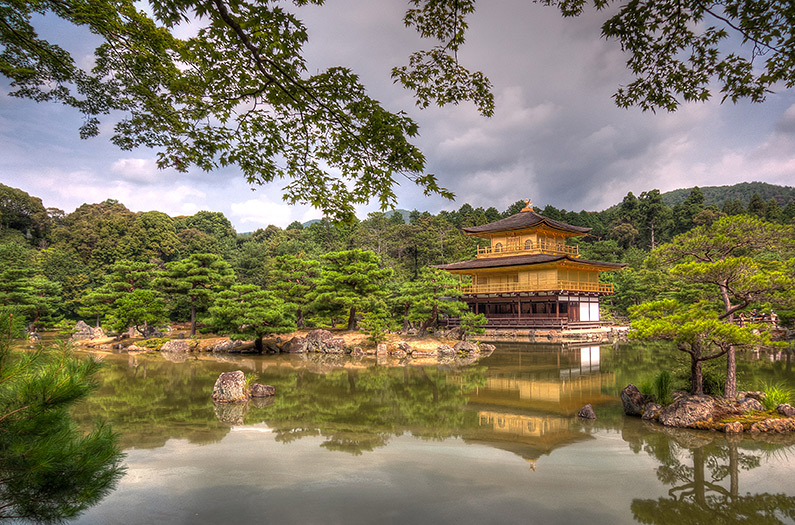
A lot of times when people come to Kyoto, they see that something is a World Heritage Site and think, Oh that must be amazing. They don’t realize that a) half the city of Kyoto is somehow one big World Heritage Site and b) just because something in Japan is a World Heritage Site doesn’t mean it’s that interesting. Kinkakuji exemplifies this perhaps the best (worst) of all. In photos it looks really cool, but when you get there, you realize it’s actually really far away in the middle of a pond:
That’s not so bad, you might say to yourself. Except odds are you won’t be at the very edge of the pond, you’ll be even farther back looking at this:
Then there’s the location. Kyoto has some layout issues I’ll get into more later, but unlike most other cities in Japan, you want to optimize what you can do in a given area because getting around is a bit of a hassle. Kinkakuji is up in the northwest corner, a half-hour walk from anything else of interest to anyone except maybe some kind of history specialist. You basically have to take a bus or taxi there, and then take a bus or taxi out. A significant time investment—one that I think most people won’t find worthwhile.
In a similar vein, here are other things travel Youtubers or blogs or whatever might recommend that I think you’d rather skip:
Kiyomizu Temple. As far as I know, the reason this place is famous is because of the scaffolded veranda. I’ve been a couple times, once for a light-up event at night, and in my opinion it’s just not worth the crowds. I think a lot of people will find it underwhelming even without crowds, similar to the issues I have with Kinkakuji—the zoomed-in photos are nicer than the distantly-viewed reality. The Ninenzaka/Sannenzaka/Gion/Higashiyama area leading up to the temple is really fun to wander around in though, so don’t skip those just because I think the temple is kinda mid.
Eating on the Kamogawa. This option is probably a little challenging for most non-Japanese readers/speakers, but I thought it was worth a mention. Every time I’ve eaten on these veranda places along the Kamo River, the food has been very mid and overpriced. One or the other I would accept because the view is nice, but not both. I have gone to one of these kinds of places when hiking in the mountains though, and that was fun (though still expensive) because you’re right on top of the stream and you have more space to relax.
This ramen place near my house I mentioned in the intro. If you happen to be in the area and there’s somehow no line, yeah it’s good. Kind of a non-traditional take on ramen. But there’s always some line and they had to introduce some kind of a ticket system. Skip.
Chao chao gyoza. I’m pretty sure this is just a chain so idk how it became so popular. Tbh I don’t even know if I’d go out of my way for it even without a line, so it baffles me people wait in line for this.
The Charm of Kyoto
What do people really like about Kyoto? I think a lot of it is the ambiance—the way the city feels like it’s managed to preserve a piece of the past. And in my opinion most of that ambiance is best experienced wandering around the quieter parts of the city. Here are some places I love:
The view from Daimonji
It only takes half an hour (for me) to get from Ginkakuji to this spot. Around sunset is best, since it looks west. I’ve never seen it at sunrise though, so maybe that would be cool too—the sun at your back. Speaking of Ginkakuji:
Ginkakuji
Not to be confused with Kinkakuji (the gold one), Ginkakuji was in theory supposed to be covered in silver, but then that never happened so it’s just wood lol. The building itself is not so impressive, but there’s this little corridor leading into the complex that makes you feel like you’re entering something secret. The grounds themselves are also pretty, with a little rock garden and typical “Japanese” garden landscape, but what really sets this place apart in my opinion is wandering around the back loop. It’s quiet, peaceful, and has this cool observation spot.
The walk itself is not anything particularly special (I guess the sakura are nice in the spring, but there are other places as nice or better), but it connects several temples that aren’t as touristy, and thus can offer that Kyoto ambiance people love. For example, Honenin, Eikando, and Nanzenji are all along or near this walk and they’re all pretty cute in their own way. Plus there’s a lot of little cafes and whatnot so you can refuel your calories from all the walking.
The Area South of Heian Jingu
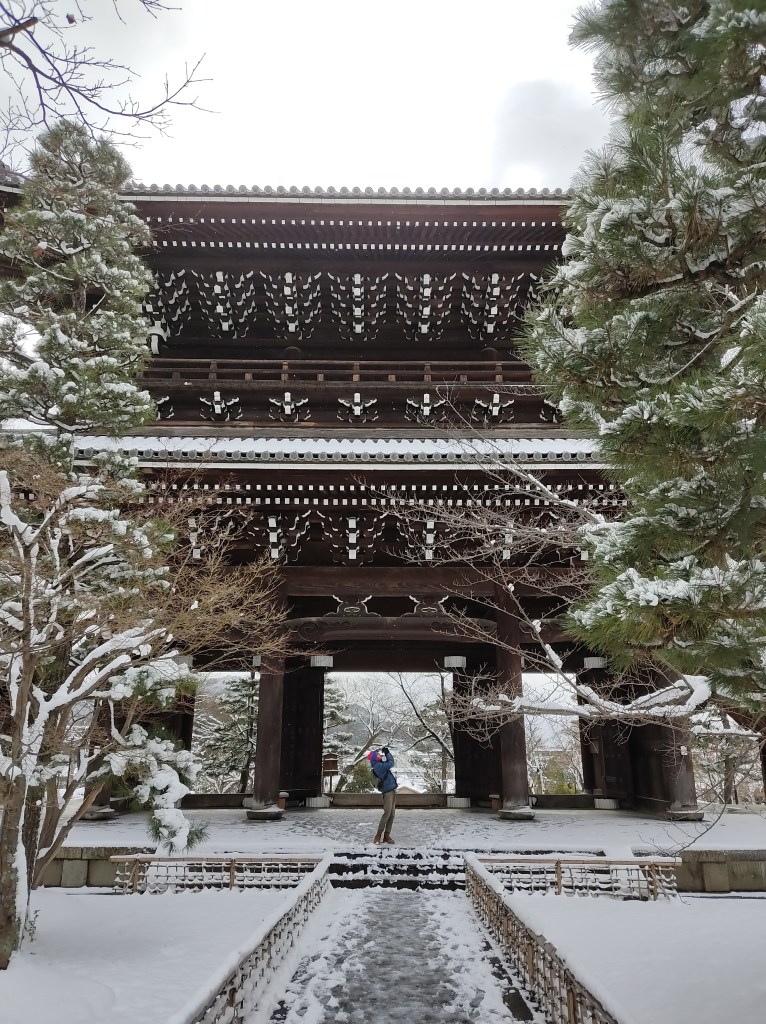
I don’t know what this area is actually called. Anyway Heian Jingu itself is kinda whatever, but the park just south of it sometimes has local events happening where shops will put up little stalls and stuff. Then as you go farther south past the museums and through the giant torii gate, you can either go along a cute covered shopping street just south of Higashiyama Station (the subway station), or if you tack farther west, you can go to Shorenin and Chionin, both of which are beautiful, quiet temples. Shorenin in particular I don’t think any tourist seeks out on purpose (I myself discovered it looking for a nice spot to see autumn foliage); Chionin is more famous because it has this absolutely majestic gate:
These kinds of gates really make you feel the Kyoto gravitas. There’s one near my old place I used to frequently walk on days off:
Bakeries
Kyoto is known within Japan as a bread place. Now my German friend will tell you there is hardly anything worth calling bread in the city, but for anyone looking for very light, fluffy pastries (savory or sweet), Kyoto is a town of many small delights. During the pandemic I started visiting a bakery about 700m (less than half a mile) from my house every Friday, and now I’m friends with the proprietor. These sorts of places are scattered throughout the city, but my feeling is that they’re centered around the area south of the imperial palace grounds. Anywhere you wander in the city, if you spot a little bakery, you might want to just poke your head in and see what they’ve got—if they haven’t sold everything yet.
Cafes
Kyoto is surprisingly a good town for coffee. I’m not really sure why within Japan Kyoto in particular turned out this way, but the story of coffee first arriving on Japanese shores is pretty funny. Dutch sailors were unable to light fires on their wooden ships, so they brewed makeshift coffee with air temperature water. When they arrived, Japanese people had never seen coffee brewed before, so they assumed that room temperature coffee brewing was how it was done, and named it “Dutch coffee”. (Sometimes it’s called 水出し/mizudashi coffee, and there might be another name I’m forgetting.) Centuries later, when the rest of the world learned how Japanese people were making coffee, they called it a Kyoto cold brew.
Ironically, Kyoto cold brews are pretty hard to find in Japan. They’re seen as kind of old-school, so you have a good bet of finding them in some of the old Showa-era kissaten cafes. Holly’s Cafe is a chain that is always brewing some. I’m not really amazed by the flavor or anything, but it is kind of cool and a simple task to accomplish while you’re out and about in Kyoto.
All that said—I think the pourovers throughout the city are great. You’re not going to find the variety of options you do in America, but the quality will be good no matter where you go. Espresso-based coffee (lattes, etc.) is also good. One thing to keep in mind though, if you’re visiting one of the smaller cafes, try to just be considerate of the limited space and keep your volume level moderate to low.
And you know what’s crazy? I haven’t even mentioned the tea. Hopefully someday I’ll learn and explore a bit more about the tea culture and have some recommendations for you.
Of course, there are other nice areas in Kyoto. Maybe someday I’ll highlight a few more. I think my overall recommendation is just to try to see fewer spots and instead build more time for wandering—you can get away from the crowds and have the kind of Kyoto experience you probably really wanted anyway.
Assorted Notes
Some more famous places you might want to skip
Here are a few more spots you might find when you research stuff to see and do in Kyoto:
Nishiki Market. This is an old shopping street with a ton of little vendors. It’s downtown so the access is good, but in practice it’s just a bunch of tourists slowly shuffling through an alley barely wide enough for two lines of people. Several of the shops themselves are worth going to (my wife likes a sashimi spot here), if only there weren’t hundreds of people to squeeze past. I would go if you have time and you’re the kind of person who likes to just buy a bunch of random street food. The reason I don’t recommend it to everyone is not even about liking crowds or not, it’s about how impossible it is to move.
Fushimi Inari. Aesthetically impressive. Crowded. I think mornings are supposed to be ok? I went during the pandemic once and it was surreal how empty it was. I will say that the area is pretty lively during the day because of the tourism, with lots of food stands and even some legit cafes. I recommend it if you don’t mind crowds.
Arashiyama. This is an area I have mixed feelings about. It’s extremely out of the way within Kyoto, and there’s not much to actually do here other than check out more temples and touristy shops, and I guess see the monkeys. The bamboo path is often a disappointment. On the other hand, it’s a pleasant finale to my favorite hike in Kyoto (you take a bus up to Takao and basically just follow the river), and the river area itself is pretty. I have a good memory of biking down the river toward south Kyoto, although unfortunately there’s nothing really worth biking to in that direction.
Nijo (Castle). I think if you are an expert in Japanese art or architecture you might like this place. The grounds are very underwhelming though.
Kyoto Tower. You don’t need to go here.
Kyoto Imperial Palace (Gosho). You don’t need to go here either.
Getting Around
(You can skip these next two paragraphs.)
Kyoto is pretty difficult to get around compared to the average Japanese city its size. There are two reasons for this, as far as I can tell. The first is the city’s restrictions on building height. In many areas you can’t build over 10m (33 ft) high—that’s about three stories. This makes Kyoto less vertical and therefore more horizontal than other Japanese cities, where high rise apartment buildings are much more common.
The second reason is more interesting. Back when the emperor used to live in Kyoto, there were significant restrictions on how large of a property you could build on, depending on your rank. Of course some of the nobility felt like they wanted to live a little larger, and so they built impressive structures around the official borders of the city (which by that time had become the right half of a former square). Plus, for a while Buddhist temples weren’t allowed inside the city proper either (except Toji and Saiji), so all those cool temples I mentioned earlier are also all around the edge of the modern city, outside the old city. Finally, soldiers weren’t really supposed to be in the capital space either, so they set up just outside as well. All that combined to make a kind of outer ring of the more interesting and less restricted building projects. Kinkakuji, Ginkakuji, even Gion and downtown Kawaramachi—all outside the old official capital space.
Anyway when you’re traveling within Kyoto, you’ll basically be on a bus or taxi, or you walk. You can bike (it’s my main form of transportation), but it’s not exactly fun—the streets really aren’t built for it, and it’s not clear to visitors which streets you’re allowed to bike on. The trains are mostly useful for getting in and out of Kyoto. The subway is kind of pointless.
Like pretty much every travel Japan channel will tell you, you should just use an IC card. It’ll work on the buses and trains (and a bunch of other things). You need one per person. It really doesn’t matter which one. You can charge them of course in the station, but you can also charge them in convenience stores. Sometimes people think, I should get a one-day pass and save money, which is a good thought but in practice is a waste of mental energy. The IC card is fine.
I should mention the bus system in Kyoto is not really a system as much as three different operators all running lines in the same place. You have
the city of Kyoto, which is 市営 (city-operated),
Kyoto Bus (京都バス), which you would think is city-operated but is just a company called Kyoto Bus lol, and
Keihan Bus (京阪バス), which is the same company that does one of the train lines running into Kyoto. (By the way, when you use your IC card on a city-operated bus, you just tap it when you get off, but on the other two you have to tap it when you get on and when you get off.)
It is very easy to get confused as to which kind of bus you’re supposed to get on. I don’t actually know any easy way for a traveler to 100% get on the right one in an intersection like Shijo-Kawaramachi, where there’s like 10 different bus stops all labeled the same thing. Google Maps is pretty good at pinpointing the bus locations for the city bus (which is nice because it used to not even try; the dot would be in the middle of the intersection), but not as good for Kyoto Bus or Keihan Bus. Getting on the wrong bus is sort of a Kyoto rite of passage though.
Where to Stay
A lot of times people stay near Kyoto Station. I think people should stay at Kyoto Station if they’re planning to leave Kyoto in a couple days or less, since in that case the bullet train access is your top priority. But the longer you stay, the more I think you should stay farther north, maybe near the Karasuma-Shijo intersection downtown. Kyoto Station is not actually downtown—it’s farther south, and while there are a lot of bus lines there, they tend to be full of commuters and tourists. Actual downtown is pretty convenient and part of the fun of Japan is wandering around the cities late at night, knowing you’re perfectly safe.
The other option, if you want to spend a bunch of money and you don’t like to wander around the city all day, is to stay in a ryokan—an old-school Japanese inn. Typically a stay in a ryokan involves a fancy dinner in your room each night, so that’s why I say it’s good if you plan to stay in at night. Otherwise you’re sort of missing the experience. Typically ryokan are not very conveniently located, so it’s a bit of a commitment. My relatives loved it though.
I can’t think of other info a traveler to Kyoto might find helpful, but if you have a question not addressed here, feel free to message me. I hope more people can really experience what Kyoto can really be when you relax your schedule a little, trust your eyes, and get out into the city.
Yuma is one of my closest friends in Osaka. He was baptized seven years ago at Mustard Seed Christian Church – Osaka, where he is currently on staff, training for pastoral ministry. Take a few minutes to listen to him talk about what God did for him and about what he believes God can do through us.
0:44 “I had a lot of questions about society”
1:31 “I was really thinking about what I want to do”
2:24 “I betrayed my friend”
3:09 “I should not exist”
4:03 “I met my first Christian friend”
5:30 “I was not interested in Christianity”
6:11 “he asked me…if I was interested in becoming Christian”
7:53 “throughout my life I was thinking I was a good person”
8:14 “I just realized what kind of person I was”
9:15 “to be a faithful Christian makes a lot of difference”